迫力の辻回しに歓声!亀岡祭・本祭『くじ改めの儀』を見に行ってきました
投稿日: 2025年10月25日
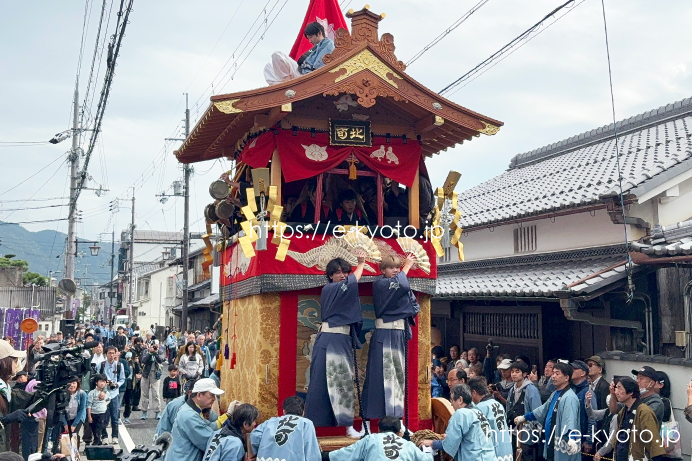
10月25日。今日は昨日に続いて亀岡祭へ行ってきました。昨日の宵宮に続く本祭の日で、朝9時半ごろからは11基の山鉾が町を巡行します。山鉾町をお囃子の音とともに進み、やがて旅籠町へと集結。11時頃には「くじ改めの儀」が行われます。
この「くじ改めの儀」とは、10月5日に執り行われた「くじ取り式」で決められた巡行順が正しいかを、奉行役の市長が確認し、通行の許可を与える儀式のこと。各山鉾の代表が順番を記したくじ札を市長に見せ、許可が出ると再び巡行を始めます。山鉾ごとに趣向を凝らした所作が披露されるため、旅籠町はこの儀式を一目見ようと訪れた多くの見物客で賑わっていました。
私も今日はこの「くじ改めの儀」を見ようと、朝10時半頃に旅籠町へ。すでに狭い通りには人があふれており、南側はロープで規制されていたので、北側で山鉾の到着を待つことにしました。
11時過ぎ、予定よりやや遅れて儀式が始まりました。先頭の“くじ取らず”の翁山を皮切りに、山一番の高砂山、三輪山、浦島山、難波山、蛭子山、武内山、稲荷山、羽衣山、八幡山、そして最後の“くじ取らず”の鍬山が旅籠町通を東から西へと進みます。特設席では山鉾の解説アナウンスもあり、それぞれの見どころが丁寧に説明されていて、とてもわかりやすかったです。
どの山鉾も個性豊かで見応えがありましたが、なかでも印象に残ったのは最後の「鍬山」。くじ改めの儀では、代表の少年が木製の鍬で地面を掘り起こす所作を見せ、観客の拍手を誘っていました。さらに巡行中には「よろしかったらヨイショ!」の掛け声とともに、鍬山が360度回転する“辻回し”も披露。目の前でその迫力を体感でき、観客席からは大きな歓声が上がりました。
最後に鍬山の辻回しを見届け、亀岡祭を後にしました。来年もまた訪れたいと思わせてくれる、心に残るお祭りでした。
Kameoka Festival 2025 — The Main Day: A Parade of Floats and Tradition
October 25.
Following yesterday’s Yoi-miya (Festival Eve), I went to Kameoka once again today for the main day of the Kameoka Festival. Beginning around 9:30 a.m., eleven yama-hoko floats parade through the streets of the castle town, accompanied by the cheerful sounds of hayashi festival music. As they make their way through the districts, the floats eventually gather in Hatago-machi, where the “Kuji-Aratame no Gi” (Lottery Confirmation Ceremony) takes place around 11 a.m.
This Kuji-Aratame no Gi is a formal ritual in which the mayor, acting as magistrate, verifies the parade order that was decided earlier at the Kuji-Torishiki ceremony held on October 5. Representatives of each float present wooden lottery tags showing their position in the procession. Once approved by the mayor, they are permitted to resume the parade.
Because each float performs its own unique gestures and movements during this ritual, Hatago-machi becomes crowded with onlookers eager to witness the scene.
I arrived in Hatago-machi around 10:30 a.m. to see the ceremony. The narrow streets were already packed with spectators. The south side was cordoned off, so I waited on the north side for the floats to arrive.
A little after 11 a.m., the ritual began, slightly behind schedule.
Leading the procession was Okina-yama, one of the two “non-drawn” floats (kuji-torazu), followed by Takasago-yama, Miwa-yama, Urashima-yama, Naniwa-yama, Ebisu-yama, Takeuchi-yama, Inari-yama, Hagoromo-yama, Hachiman-yama, and finally the second kuji-torazu, Kuwayama, bringing up the rear as they proceeded west along Hatago-machi Street.
A live announcer provided explanations of each float from the special viewing area, describing their historical background and artistic features in detail—it made the entire event much more engaging.
All of the floats were impressive and full of character, but the one that left the strongest impression on me was the final Kuwayama.
During the Kuji-Aratame no Gi, a young boy representing the float performed a symbolic act of turning over the earth with a wooden hoe, which drew warm applause from the crowd.
Later, during the parade, the float performed a dynamic “Tsuji-mawashi”—a 360-degree turn at an intersection—accompanied by the rhythmic chant, “Yoroshikattara—Yoisho!”
Seeing it up close was truly thrilling, and the spectators erupted in cheers.
After watching the final Tsuji-mawashi of Kuwayama, I left the Kameoka Festival with a heart full of admiration.
It was one of those festivals that makes you want to come back again next year.